How grid bots work
Molton, Tusk and Stingo are grid bots. Here is how a grid opens and closes trades, where it does well, where it struggles, and how to run one safely.
Grid bots are among the most popular Expert Advisors, and among the most misunderstood. Run with care, they can produce steady results in the right markets. Run carelessly, a grid can lose a large part of an account. This article explains how they work so you can tell the difference.
Molton, Tusk and Stingo are Nectabot's grid bots. Each one works a little differently, but the core idea is the same.
The basic idea
A grid bot does not try to predict the exact turning point of the market. It places a series of trades at set distances, called the grid step, and manages them together as one group, called a basket.
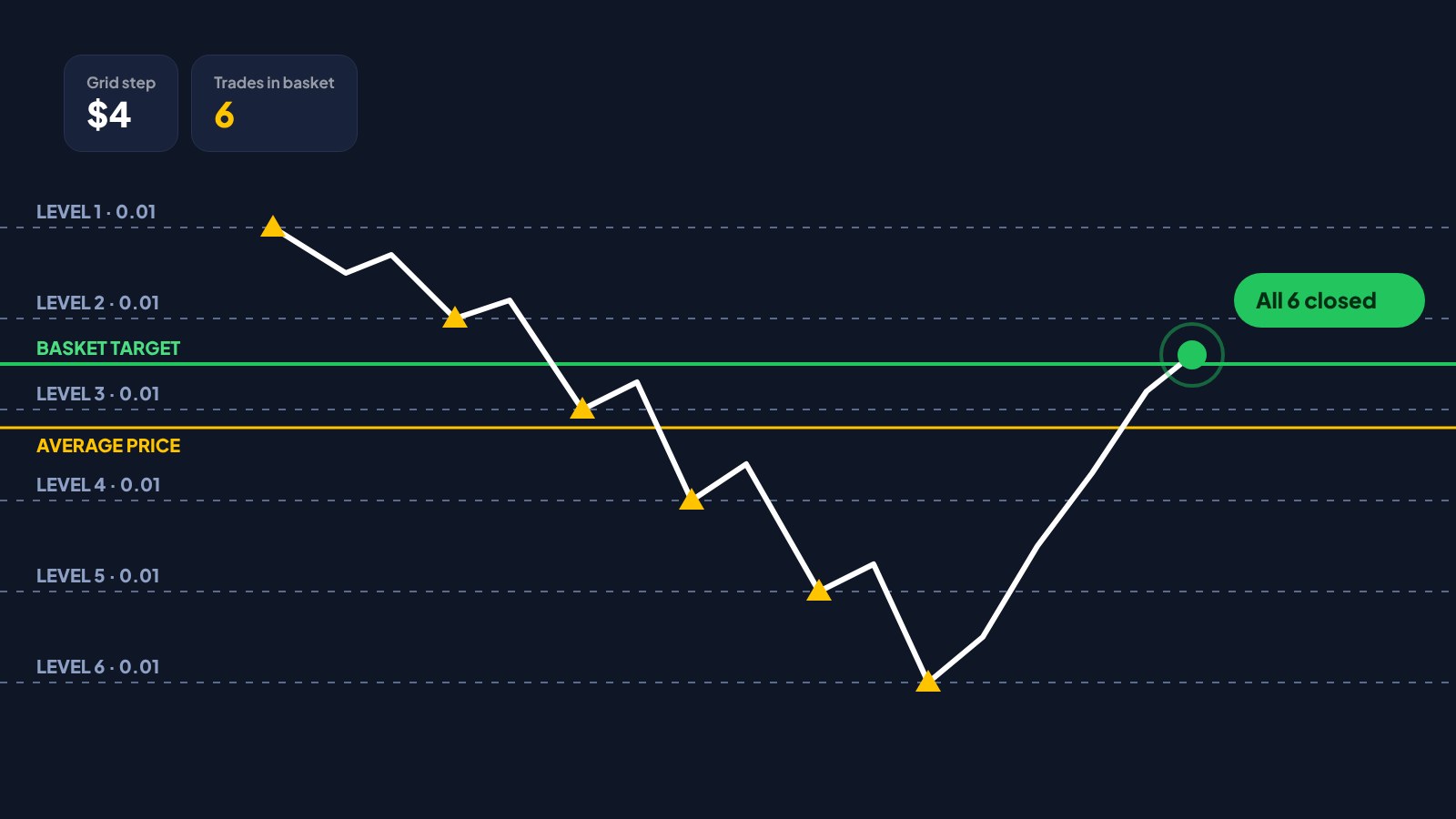
Here is a simple buy grid on gold:
- The bot opens a first buy trade.
- If price falls by the grid step, for example $4, it opens another buy.
- If price keeps falling, it keeps adding at each step.
- When price comes back up enough that the whole basket is in profit, the bot closes every trade in the basket at once.
Because the later trades are opened at lower prices, the average entry price of the basket falls as the grid grows. Price does not need to return to the first entry for the basket to close in profit. It only needs to bounce partway.
Flat grids and martingale grids
In a flat grid, every trade uses the same lot size. Molton works this way.
In a martingale grid, each new trade is bigger than the one before, for example 1.2 or 1.5 times. This pulls the average price down much faster, so the basket closes on a smaller bounce. The cost is that the total position grows quickly as the grid deepens, and so does the risk. Stingo and Tusk use a lot multiplier.
Where grids do well
Grids do best when price moves up and down within a range. Each swing gives the basket a chance to close in profit, and the bot repeats the cycle many times. In these conditions a grid can win a high share of its baskets.
Where grids struggle
The danger is a strong move in one direction that does not come back. The basket keeps growing against you and the floating loss deepens with every level.
To see how quickly it adds up, take a flat buy grid on gold with a $4 step and 0.01 lots per trade. After a $40 fall there are ten open trades. The first is $40 under water, the next $36, and so on. Together that is a floating loss of about $220 for a basket that started with a single 0.01 lot trade. With a martingale multiplier the same fall costs several times more.
This is why grids tend to show many small wins and, rarely, a large loss. The win rate looks excellent right up until the one move that does not reverse.
The protector is not optional
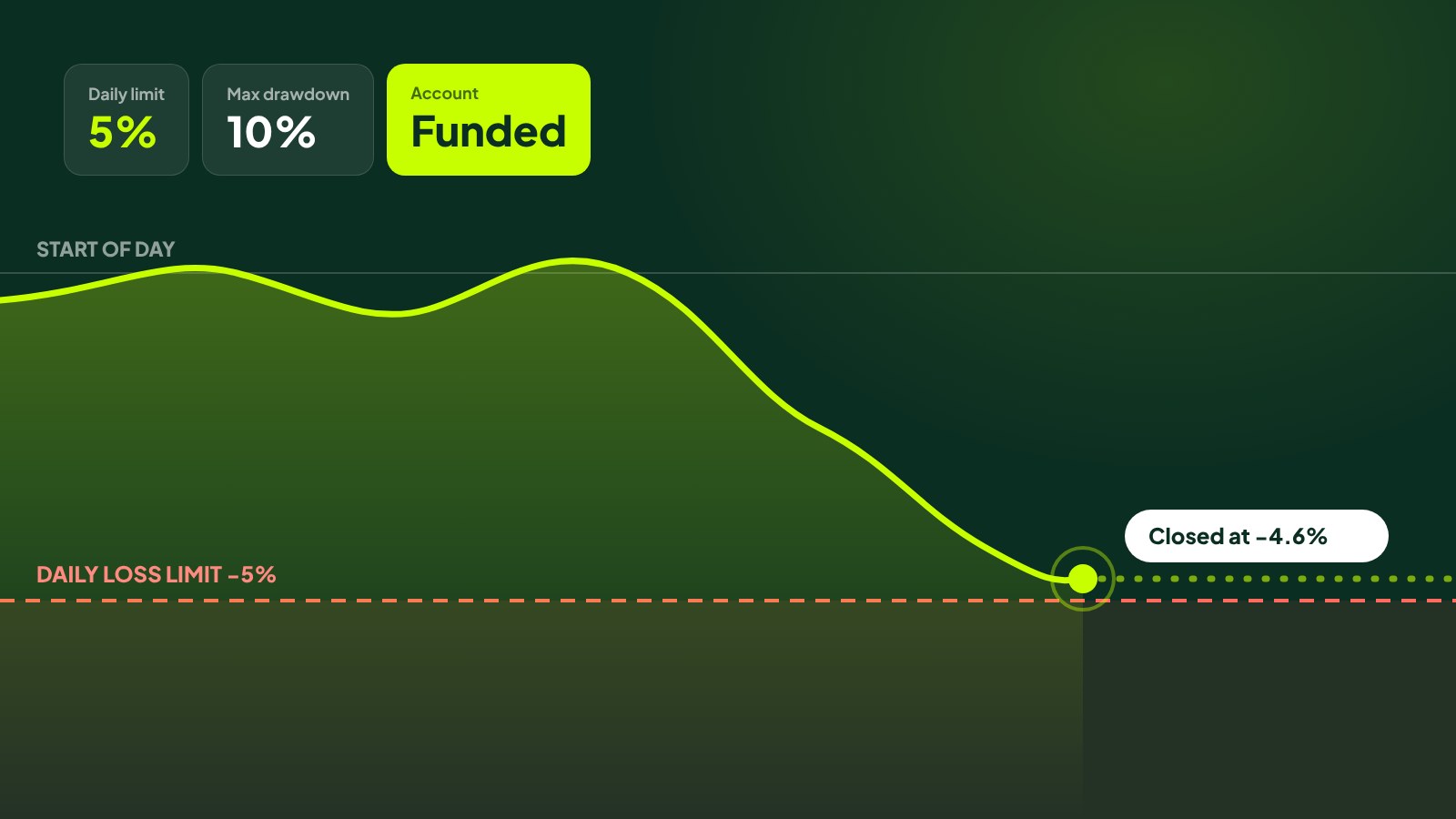
Every Nectabot grid bot has a protector: a hard limit that closes the basket when the loss reaches a set level, such as a share of the day's starting equity. Molton ships with its daily protector switched on. For Stingo and Tusk we strongly recommend running one, either the bot's own or the free Fendox equity protector.
A protector turns an open-ended loss into a defined one. You will take that loss sometimes, and that is the point.
How to run a grid more safely
- Trade it on capital you can dedicate to it, not your whole account.
- Keep the protector on and set it to a loss you can accept.
- Start at the lowest risk setting and raise it only after weeks of live results.
- Test it on your own broker first. Spread and swap matter more for grids than for most strategies, because trades are held longer.
- Check the risk of your exact settings with the free Gridmo grid calculator before you start.
In short
A grid bot is a tool for a particular kind of market, with a particular kind of risk: frequent small gains and occasional large losses. Used with a protector, sensible risk and dedicated capital, it can earn its place in a portfolio. Used without them, a single trend can wipe out months of gains.